Showing posts with label norse. Show all posts
Mimzy


((I think you all know that I'm not an expert by now so I'll skip over the disclaimer and just mention that today's image is an illustration of Wagner's opera Das Rheingold by Arthur Rackham))

Who: Thor (Þōrr), Member of the Avengers brought to you by Marvel Comics!

What: Personification of thunder. God of thunder, lighting, rain that brings crops, fair weather, war, and protector of the gods and mortal men.

This article would have actually been posted up last week if I hadn't shown it to the Roommate first. She took one look at it and asked me why I was so angry. Initially, I protested that I couldn't be angry at a person who I think of as fictional, but realized that she was right. No, I wasn't exactly angry at Thor, but I was angry at Nazis. And really, being Nazis, they deserve the rabid dislike I feel for them. Out of all of the Norse gods, Thor has retained the biggest presence in the public eye which has been good and bad for his everlasting rep.

The Good: He has his own comic book series, not to mention an upcoming movie just about him. He'll also be in the Avengers movie if that gets made.

The Bad: Ideal poster boy for the Nazi's 'master race' scheme. The religious symbol of his crossed hammers is now better known as the swastika and, this needs repeating, the Nazis liked him. To quote an LOL cat, the Nazis liking anything is a big DO NOT WANT for whatever that thing is.
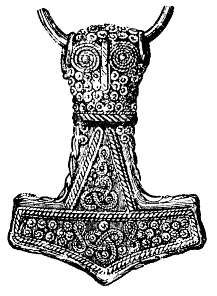

However, if you can put aside the corruption of asshats (that's a scientific term) who steal symbols to twist them to evil purposes, then Thor himself was a pretty cool guy. He was, by far, the most popular of the Norse gods partially because, unlike Odin, he didn't require any human sacrifices. As far as the mythology goes, Thor is in more stories then any other god. He was also the god that the people were the most reluctant to give up. His aforementioned religious symbol didn't start out swastika shaped. Originally, the symbol was a regular hammer shape which the wearer wore upside down. (See image) When Christianity came to the area the believers, wanting to cover both of their bases, started making symbols of two hammers, crossed into an X, in a sort of cross and Thor mix. This symbol eventually turned into the infamous swastika. I've been told (but have found no evidence to back it up) that the German Iron Cross was based on the crossed hammers as well, but I don't know how true that is.

Thor was one of Odin's many children who he had with the giantess Jörd. In appearance, Thor was a big burly man with red hair and a bushy beard. Physically, he was the strongest of the gods, but he still had plenty of items to increase his strength. Around his waist he wore the belt Megingjord which increased his strength and he also had the iron gauntlets Járngreipr which enabled him to wield his most famous weapon, the hammer Mjöllnir. He was married to the goddess Sif, who was a golden haired goddess of fertility. With her he had at least one child, his daughter Thrud, and possibly a son. However, like his father, Thor was known to sleep around with giantesses and had his two most famous children, Magni and Modi, with the giantess Járnsaxa. Magni and Modi are really only worth mentioning as they will be one of the very few persons to survive Ragnarok and will come to rule the world in the mythic future.

One of my favorite things about Thor is that his worshipers felt comfortable enough to be able to have a bit of fun at his expense. Such was the case when Thor, in a hissy fit, lost his hammer.

How Thor Got His Hammer Back

Now I say 'lost his hammer,' but the mythology is unclear. My favorite retelling of the story has Thor, in a fit of impotent rage, going fishing for Jörmungandr (the Midgard serpent). After fishing the monster up he threw Mjöllnir at it and, to his horror, the serpent swallowed the hammer. Later, the serpent threw the hammer up onto the shores of Jotunheim, the home of the frost giants which starts the story. However, the other version of the tale has Mjöllnir being mysteriously stolen in circumstances that are unclear. Since this story only appears in the Poetic Edda and I only have access to the Prose, I'm going to have to go with what Wikipedia says... Which means that the hammer goes missing for reasons unclear. Blast it. The fishing story is kind of funny.

After realizing that his hammer had gone missing, Thor rushed over to the only person who might have taken it, Loki. "Do I look that stupid to you?" Loki asked, after Thor had asked him if he'd stolen Mjöllnir. Thor decided not to answer and instead asked Loki to go out and find the hammer. Grumbling, Loki went to Freyja and borrowed her feather robe which would allow him to take the form of a hawk for the search. After flying all over Midgard, Loki met the giant Thrymr who admitted that he had hidden Mjöllnir away. Thrymr promised to return the hammer... but only if he could have Freyja for his wife. Loki returned with this information and Thor hurried over to Freyja's home to tell her to get ready to be married. When Freyja heard about her upcoming nuptials, she threw a fit. So angry was she that her beloved necklace Brísingamen burst into bits. Giving Thor a piece of her mind, she flatly refused to marry the giant and stormed off.

Surprised that she had refused, Thor called a council of the gods who, to his greater surprise, sided with the goddess. Yet, they agreed that the idea of Thor without his hammer was a horrifying one and tried to figure out a way to get it back. Heimdall, quick to come up with a plan before anyone could think of a better idea that didn't involve cross-dressing, proposed that they go through with the marriage but send Thor as the bride! Needless to say, Thor was not amused by this idea and protested that it would be unmanly for him to dress in woman's clothing and regain his hammer through deception. Loki, agreeing with Heimdall for the first and last time, pointed out that if Thor didn't do this then the giants would probably invade Asgard. So Thor grudgingly agreed.

They went to Freyja who, happy that she wasn't going to be the bride, lent Thor some of her clothes as well as her suddenly repaired necklace and her chariot pulled by cats. Miserable, Thor got into the chariot and was further annoyed when Loki ran up, also in woman's clothing, and hopped inside. "I wouldn't miss this for the world," he cheerfully told the other god.

Together, they rode north to Jotunheim until they arrived at Thrymr's kingdom. Once there, Loki claimed he was Freyja's handmaiden and presented his 'mistress' to her future husband. Overjoyed, Thrymr ordered the start of the marriage feast at which Thor ate an entire ox, eight salmon, all of the baked goods intended for the women, and washed it down with three measures of mead. Puzzled, Thrymr turned to Loki and asked him if Freyja was always like this. He'd never seen a woman eat or drink so much before! Not to mention that when he had briefly pulled aside her heavy veil to steal a kiss he'd seen her eyes to be rimmed with red. Loki, thinking quickly, replied that 'Freyja' had been so excited about the upcoming marriage that she hadn't slept or eaten for the eight days. "Be a man," Loki secretly told the other god. "If I can go through childbirth, you can pretend to be a woman for a couple more hours." Thor did not think that this was a fair comparison since Loki didn't seem to entirely mind doing unmanly things, but managed to make it through the rest of the feast without breaking his cover.

After the feast was over, Thrymr ordered the start of the marriage ceremony. As with mortal marriages of the time, the key component was when a hammer was laid on the bride's lap. In mortal ceremonies, this ritual was supposed to be a fertility blessing for the bride. In this ceremony, it was the moment Thor had been waiting for. As soon as the giants had laid Mjöllnir on his lap, he seized it and slayed everyone in the room except for Loki who I like to think was busy giggling hysterically in the corner. Once Thor was done killing everyone, Loki approached the other god. "Feel better?" he asked.

"This never happened," Thor grumbled, pulling uncomfortably at his blood drenched clothes. "Got that? This. Never. Happened."

"Of course not," Loki said. And then promptly went and told everyone who would listen about the time that he and Thor had to cross dress and Thor got married to a giant. Surprisingly, he left off the bit where Freyja gave Thor a tongue lashing Part II when she saw that Thor had ruined her favorite dress, but maybe that last bit is only in my mind.
Mimzy
(Today's primary source is Myths of the Norseman by H.A. Guerber, as well as the Prose Edda of Snorri Sturluson translated by Jean Young. Today's picture was drawn by John Bauer and was found via Wikipedia.)

Who: Loki the Trickster god, father of monsters, Prince of Lies.

What: Personification of fire, especially fire that is underground. The reason why there are earthquakes, volcanic eruptions, geysers, hot springs, etc.

One of the major reasons why I am so drawn to the Norse myths is that, like Christianity, the myths define a clear past, present, and future. The mythic past is where the world was created, where the gods rose to power, and where they had most of their adventures. The mythic present is now and forever until the mythic future comes. It is at the end of the mythic past and for the entirety of the mythic future that Loki takes center stage.

Loki is probably the most difficult to describe of all the Norse gods. This is likely because he doesn’t seem to fit into European traditions of myths at all. With his tendency to create problems for the gods, but to always have the gods come out ahead, he more closely resembles the Trickster figure from some Native American and African traditions then anything else. At the same time, the Loki found in the mythic present/future closely resembles Lucifer from Judeo-Christian traditions. They’re both unabashedly evil and out to destroy all of mankind.

Yet it didn’t start out that way. Shortly after the world was made, Odin and Loki met and the two became sworn blood brothers for reasons left unexplained. It is very likely that this oath was made in an attempt by Odin to prevent Ragnarok. This attempt would ultimately fail, but for the moment Loki was on the god’s side. To commemorate their oath, Loki gave mankind the blood within their veins and instilled in us our passions and hot-headedness. Loki then moved into Asgard with the rest of our cast and fell into a pattern of annoying the hell out of everyone and escaping their wrath by the skin of his teeth.

Loki had at least eight children, but the most famous of these would be Sleipnir, Hel, Fenrir, and the Midgard serpent. Sleipnir was an eight legged horse which became Odin’s steed, actually born by Loki while he was in the form of a mare. Hel, Fenrir, and the Midgard serpent were all mothered by Angrboda, one of Loki’s wives. Loki had been hiding these three children when they were discovered by Odin and the others and deemed too dangerous to be allowed to be free. The Midgard serpent was cast into the sea, presumably so it would drown, but the monster grew to an enormous size until it encircled the world, coming around to bite its own tail. Fenrir, a giant wolf, was briefly kept as a pet by the war god Tyr, but we’ll get to that when we get to him. Hel, one of Loki’s only female children who was half beautiful woman and half rotting corpse, was cast into Niflheim, the underworld, where she was made the ruler of all who died of illness or old age. There’s no reaction given by Loki telling what he thought of the treatment of his children, but as he initially tried to hide them from the gods it’s likely that he wasn’t too happy about it.

There are plenty of ‘Loki annoys the gods’ stories, but I have to tell you one that shows that the gods usually always benefitted from Loki’s tendencies.

Sif, Thor’s wife, was well known for her beautiful golden hair which she prized highly. Yet, one morning the couple awoke to find that Sif had been shaved bald! Thor was outraged and swore to punish the one who had done this to his beloved and marched right over to Loki who saw him coming and fled. Unfortunately for him, Thor managed to catch him and began strangling the other man to death. Loki managed to get free and began to beg forgiveness from the more powerful god, promising that he would bring Sif a new head of hair, one made out of pure gold that would have the ability to grow like real hair. Thor thought this over and agreed that such a gift would be excellent penance and let Loki go.

Loki immediately ran to Svart-alfa-heim, the home of the dwarves and dark elves, and begged Dvalin, a dwarf, to help him make the hair as well as gifts for Odin and Freyr. (Remember from my article on Odin, that Odin, Thor, and Freyr were worshipped as a triple god.) Dvalin agreed, and created the spear Gungnir, a spear which never missed it’s mark, for Odin, the ship Skidbladnir, a ship which could sail the air and sea as well as be folded up to fit in your pocket, for Freyr, and Sif’s hair. Overjoyed with the gifts, Loki declared that Dvalin’s son Ivald was the greatest smith known. The dwarf Brokkr overheard the god’s praise and declared that his brother Sindri was an even more skilled smith and would be able to create items of greater worth and magical power. Thinking that this would be an easy way to get more treasures, Loki challenged Sindri’s skill, wagering his head for Brokkr’s that the dwarf couldn’t create the better items.

Sindri accepted the bet and with Brokkr manning the bellows, set to work. Loki then had a moment of doubt. He was rather attached to his head and didn’t want to risk losing it in a bet so he decided to try and sabotage the dwarves. Turning himself into a gadfly he stung Brokkr’s hand, hoping that this would cause the dwarf to falter and stop pumping the bellows. It didn’t, and Sindri produced his first item the boar Gullinbursti, which radiated light from its golden bristles and could run through the sky, for Freyr. He then got to work on his second treasure.

Loki, seeing the wondrous boar, got a little more nervous about the bet. Turning himself into a gadfly again he flew over and stung Brokkr on the cheek. Yet, the dwarf still didn’t falter and Sindri removed his second treasure from the flames. It was the arm ring Draupnir, an emblem of fertility which would drop eight rings every ninth night, which was for Odin. By now Loki was a little desperate so when the dwarves started on the third treasure Loki stung Brokkr over the eyes, drawing so much blood that he had to pause in order to wipe his brow. This managed to damage the third treasure, the hammer Mjollnir which always returned to its owner’s hand, by causing the handle to be too short. Despite this, Brokkr and Sindri knew that their gifts were the best so they went to Asgard with Loki to present them to the gods.

Despite the usefulness of the ship and spear and the loveliness of Sif’s new hair, the gods declared Brokkr the winner as Mjollnir, in Thor’s hands, would be an invaluable weapon against the giants. Realizing his head was forfeit, Loki attempted to flee again, but was brought back by Thor. Thor gave Loki to Brokkr, but forbade the dwarf from actually taking his head. Unable to claim his full vengeance, Brokkr decided that the next best punishment would be to sew Loki’s lips shut which he promptly did. Loki meekly accepted his punishment until he got sick of tolerating the god’s gibes in silence and got the stitches taken out. But the gods were able to keep their wonderful treasures, many of which would be very useful in the myths to come.
Mimzy
(Today's primary sources are The Prose Edda of Snorri Sturluson translated by Jean Young, Myths of the Norsemen by H.A. Guerber, and The Norse Myths retold by Kevin Crossley-Holland. Today's image is 'Odin the Wanderer' by Georg von Rosen.)

Who: Odin (or Wodin), King of the Gods, Leader of the Æsir, the Allfather.

What: Personification of the atmosphere. God of rushing wind, war, wisdom, those who die a noble death in battle, poetry, and those who die from hanging. Creator of all life and runes.

Rules: All of Asgard. His halls are Valhalla where the dead go, Gladsheim where the gods meet, and Valaskialf where he watches all of creation.


In Sturluson's Prose Edda, the King of Sweden, Gylfi, traveled to Asgard in order to find out about these gods he'd heard so much about. Upon arrival he was directed to Valhalla where he saw three thrones stacked one upon the other with a man seated in each. These men introduced themselves as High One, Just-as-high, and Third and proceeded to tell Gylfi everything about the gods in question and answer format. High One, Just-as-high, and Third are supposed to represent Vili, Ve, and Odin. At the same time they only represent Odin. You see, it is very likely that Odin was a triple god with his brothers being aspects of him. For proof of this, most people point to the Lokasenna where Loki attempts to pick a fight with all of the gods at once by airing all of their dirty laundry. When Frigg attempts to hush him he accuses her of having an affair with Vili and Ve. Normally, this sort of rumor would have been devastating for the Queen of the Gods, but no one seems to take any real notice of it. Due to this, people more scholarly then I have said that as Vili and Ve are aspects of Odin, they are also technically the husbands of Frigg.

Odin was described as being an elderly but vigorous man of around fifty years (think of the life expecancy of ages past before you yell at me to say that 50 isn't old) with gray curly hair and a long beard. He dressed in blue and gray, the colors of the sky he represented, and carried with him the spear Gungnir which never missed it's mark. Odin's most striking feature was that he only had one eye, although I don't think it's mentioned which eye was actually the missing one. He lost his eye by trading it for a drought from Mimir's (memory) well. After plucking out his eye and casting it into the well's depths, Odin obtained all of the world's knowledge and wisdom. Odin also created runes, the early Germanic alphabet, by hanging himself over Mimir's well for nine days and night while peering into the well's depths. To do this, Odin was not hung as if he were being executed, but instead was positioned like the Hanged Man tarot card.

The most interesting thing about Odin, to me, was how fond he was of traveling amongst humans. To do so he usually dressed himself all in gray, donned a wide brimmed gray hat so no one would notice his missing eye, and introduced himself as Gangrad to all that met with him. (This is a Tolkien alert to any and all who are interested in how the Grand Master of fantasy came up with his ideas.) Once disguised, he would wander among humans helping those that needed it and punishing those that deserved it. In fact, Odin enjoyed wandering around Midgard so much that at one point all of the gods thought that they would never see him again. Taking advantage of his absence was Vili and Ve who quickly took over and even made Frigg their wife. (Hence Loki's accusation above and the reason why it didn't matter that much.)

Despite being the leader of the gods, there is some evidence that he was not the most important of them. As far as stories go, there are fewer stories about Odin then there are about other deities such as Thor and Loki. In fact, out of all the gods, Thor probably has the most stories about him. Additionally, in the Lokasenna when Loki is insulting everyone in sight it's only when Thor arrives that Loki is put in his place and leaves. Odin had been there the entire time trying, and failing, to quiet him.

Odin was worshipped in many temples, but the most imporant ceremonies were supposed to be held in Uppsala (today known as Gamla Uppsala) where the kings of Sweden ruled. According to Adam of Bremen, an eyewitness from the 11th century, this location was where the trinity of Odin, Thor, and Freyr were worshipped, with Thor sitting on the highest throne. While you can't really trust Adam entirely as he was a Christian missionary in a time when Christianity is trying hard to push it's way north, he is a rare eyewitness in a time when very few written records survive. To Odin, horses were supposed to be the sacrifice of choice, although human sacrifices could be made during times of great need. I've read that once a king had himself sacrificed in order to placate the gods and save his people, but I've never been able to find source that says who this king was or when it happened. The cloest I've ever found to his story was the tale of King Aun of Sweden who sacrificed his nine sons to Odin in order to obtain a longer life. Our friend Snorri reports on this in his Heimskringla and there may be some truth to this tale as, according to Adam of Bremen, nine male animals were sacrificed to the gods at a time. Although in this case, the sons were sacrified one at a time instead of all at once.

Notes: Here's a fun fact for ya! Odin is one of the major sources behind Santa Claus! While the start of the Santa Claus myth comes from Saint Nicholas of Myra, you've got to admit that his being from Turkey doesn't really match up with tales of the North Pole. However, Odin is the origin of the stories of the Wild Hunt, a frightening hunting party that roared through the air on dark nights around the season of Yule. Plus, Odin's horse was the eight legged Sleipnir while Santa has his eight flying reindeer (before Rudolph who is a late addition). Lastly, while in Valaskialf, Odin could see all of creation and what he couldn't see his crows Hugin and Munin went out at saw for him. So, Odin Claus could definately spy on all of the little children to see if they'd been naughty or nice. Okay, at Christmas I'm going to write an entire article to prove this to you!

I also have it on good authority that Gary Corby is a direct descendent of Odin. And by good authority I mean Gary said so. You know that it has to be true, because you saw it on the internet!
Mimzy
Since I'm a big fan of world mythology I've decided to do a series of posts on the gods of old. First up shall be the Norse, since I love them most, followed by the Greeks. Then, if I don't loose interest first, I shall do a tour of the Mediterranean with the Babylonians and Egyptians before finishing up with the Celts. While this doesn't even begin to cover the 'world' part of world mythology I'm a little uncomfortable with talking about current belief systems as if they were myths. So while I may talk about the Aztecs I won't be writing about any Asian, African, or Native people's beliefs.

Now on to the Norse!

(A word of warning! I am not an expert on any mythology. This is a fascination and a hobby of mine, but I don't know enough to even begin to claim I'm an expert. There will be times where I'm wrong, and if you notice that I am, please tell me!)

A few years ago, if someone had asked me about Norse mythology I would have probably said "it's interesting, but we don't know much about it." This is untrue. Scholars actually know a lot about the Norse gods and goddess, but unfortunately there aren't many direct sources. Most of the written records for Norse myths were written only after Christianity had become the dominant religion of the area. The two major works that collected the Norse myths are the Prose Edda, written in the 13th century by Snorri Sturluson, and the Poetic (or Elder) Edda, which was also written in the 13th century by an unknown author.

While the Elder Edda seems to be a collection of minstrel songs that deal with Norse myths, the Prose Edda is very obviously biased in Christianity's favor. In order to explain how the Scandinavians came to worship their gods, Snorri wrote a foreword describing how Odin and his kin were actually super-powered humans from Troy who traveled north and tricked people there into thinking they were gods. (I'm not kidding.) There are also several gods that I would suspect were edited to make them follow Christian beliefs closer. Whether this was done by early missionaries to try and convert people, or by the pagan believers to try and make their native religion seem less threatening to the early church (or even if it was done at all!) I wouldn't know. I'll have to get that time machine working to figure it out.

The thing, to me, that is really interesting about the Norse myths is that it's inhabitants are in a constant battle against fate itself. Ragnarok, the end of the gods, is always looming and nearly every story is about how the gods are trying to keep the end at bay. Unfortunately for them, many of the actions they take only hasten it's approach. But I'll get to that when I write about Tyr and Balder. For worshipers, every year that passed meant that the gods had held off the inevitable for a little longer. However, before we dwell too much on the end, we should start at then beginning.

(Today's primary source is The Prose Edda of Snorri Sturluson, translated by Jean Young. It's currently out of print, but the Penguin Classic version is great if you're desperate to read it.)

In the beginning, there was nothing but Ginnungagap, the void. Then, the first land Muspell appeared. It was a land of heat and fire where the well Hvergelmir was. In this land dwells Surt, a giant with a flaming sword, who will come at Ragnarok to burn the world. From the well Hvergelmir flowed eleven rivers which went north into the void and turned it into a sea of ice. The ice grew thick, cold, and treacherous and became Niflheim which would become the location of the underworld. In between the fire and ice was a pleasant place where life began. From the melting ice at Niflheim's border came the giant Ymir who is the ancestor of the gods and giants.

This is where things start getting a little weird. You see, Ymir fathered the Jotunn (Frost Giants) while he was asleep. From under his left arm grew a man and woman while one leg got the other leg pregnant and gave birth to a six-headed son. These were the first frost giants and the beings that the gods shall soon be in eternal battle with.

The frost of Niflheim continued to thaw and from the ice came the cow Audhumla. Now Audhumla was the best dairy cow ever as her milk was so plentiful that four rivers of milk flowed from her which fed Ymir and his giants. Audhumla herself survived by licking the ice and she quickly licked the man Buri from it's depths. Buri sired a son named Bor who in turn sired Odin.

While I'll talk about Odin a great deal next time, all you need to know about him now is that he had two brothers, Vili and Ve. Now, I'm not sure why, but Odin and his brothers decided that killing Ymir was a great idea. They did so, and Ymir bleed so much that it drowned all the giants except Bergelmir and his wife who escaped. We'll have to assume that the blood flood also killed Audhumla since I have never seen another mention of her. The brothers then took Ymir's body to the middle of Ginnungagap and made the world from his flesh. The seas were made from his blood, the mountains from his bones, plants from his hair, the sky from his skull, and clouds from his brains. Taking fire from Muspell they made the sun and the stars and put them in the skies. They also took Ymir's eyebrows and built a wall around their world which would hold in the seas and block out the jotunn who were pretty ticked about the whole 'murdering their esteemed Grandfather and the flood of blood' thing.

Their world complete, they named it Midgard or, for all you Tolkien lovers, Middle Earth.

While walking their world, Odin and his brothers found two trees washed up on shore. Having nothing better to do, they brought the trees to life making the first man and woman. The man was named Ask (ash-tree) and the woman Embla (elm-tree). The brothers then built themselves a fortress in the middle of the world which they named Asgard. There, they settled down, got married, and started making many little god-lings. Or at least Odin did, because Vili and Ve are about to vanish from mythology. And never mind the fact that there were no goddess to make god-lings with. The jotunn must have bred quickly while the world was being made or something.

NOTES:
It's interesting that the Norse quite happily put themselves in the center of the world between what sounds suspiciously like the Arctic (Niflheim) and the Sahara (Muspell). While everyone knows that the Vikings did a lot of traveling around in northern Europe, they must have also been pretty aware of what things were like south of them as well. That said, descriptions of Midgard have a flat-world feel to them despite the Vikings knowing that the world was round. They were, after all, the first (non-successful) European people to try and colonize the Americas. I suspect that the mythology came before anyone tried to sail to Canada and wasn't updated to reflect what the sailors knew.

Also, just like Christianity and many other religions, we have mankind's beginnings starting with massive amounts of incest. Seriously gods, if you want worshipers you need to create a couple hundred people, not two. I'm surprised that more people didn't end up with webbed feet.